My mother ruined my life on a Tuesday.
That’s when she announced I would be leaving my friends behind to attend an all-girls Catholic high school, donning the obligatory navy-and-white uniform—the nun-in-waiting attire—and spending my last summer of freedom slogging through eight assigned classical works instead of beach books. The sisters at St. Cecilia’s had no concept of “Hot Fun in the Summertime.” I was not consulted.
To compound the felony, Mother had a plan for orientation day. “I have a dear friend named Mary,” she said. “You and I are going with Mary and her daughter Diane.”
I had already learned, through prior experience, that I was expected to endure the children of my parents’ friends without question. I had not yet learned that this particular instance would not require endurance.
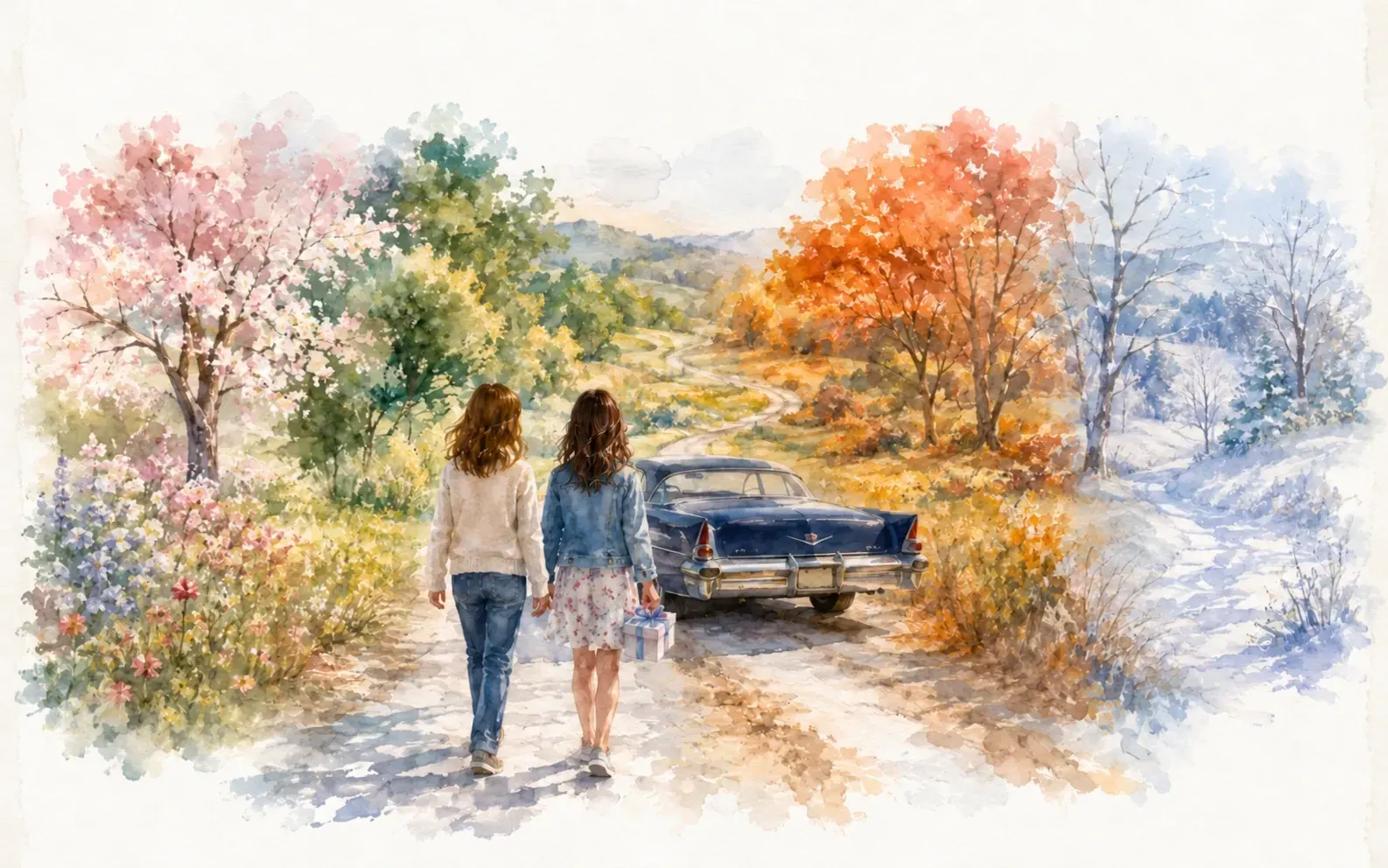
Mary arrived in a brand-new 1968 Cadillac—a land yacht, still smelling like the showroom. Diane and I were arranged in the back seat by our mothers, who were under the impression they were being subtle. We rode to school in complete silence and rolled our eyes in unison when they weren’t looking.
During the break, we ended up in the girls’ room together. That’s where the intelligence exchange happened. She was half Greek. I was Greek. We were the only two Greeks in the entire school. We had been fed identical PR by our respective mothers. We compared notes, chuckled politely, and made a solemn agreement: we would remain vigilant against any future attempts to force us together. Our mothers were not going to win this one.
The plan backfired within a week.
We discovered we hadn’t finished our summer reading—neither of us—and pooled our allowances on CliffsNotes in a last-ditch effort to survive the first week. We studied together. Diane, with eight years of Catholic school survival already logged, gave me the crash course. By the time school started, friendship was already a fact. Our mothers knew exactly what they were doing. We had simply been the last to find out.
What Diane did not know—what she would not find out for some time—was that I was an avid reader when the subject interested me. The summer reading list did not interest me. Diane did not know this distinction existed.
When she spotted an Evelyn Wood Speed Reading introductory session, we decided it was God’s solution to our unread book problem and our mothers’ restrictions on unsupervised outings. One of us called for information and learned we’d be using Goodbye, Mr. Chips. I told my mother I needed the book for school. I read it cover to cover the night before the session.
The next day, I sat in my chair and flipped through the pages at record speed, raising my hand for nearly every question the instructor asked. Diane freaked out. She genuinely believed she had witnessed a speed-reading prodigy materialize overnight in the back seat of her mother’s Cadillac.
I let her believe it. For a while. A good while.
When I finally came clean—on my own timing, because that’s when the bit was over—she realized she’d been had from the opening move. The read was not speed. The book was already done. The whole performance was a setup.
We still relish that one.
We escalated. Someone was selling little boxes that made animal noises when you turned them over. We recruited willing participants, distributed the inventory, and one day brought Old MacDonald’s farm to Mrs. Hall’s English class.
High school was an extended operation. Late-night phone calls from under the covers, laughing ourselves sick over Ronco commercials and televangelists. Jim Bakker once intoned, “Christ walked to Calvary for you; won’t you walk to your telephone for him?” We walked to our telephones for each other instead, for decades, in every direction.
When we were old enough to drive, Diane kept a five-man life raft inflated in the trunk of her navy Malibu. For a decade. Ready for water wherever water appeared. Six of us once stuffed ourselves into it in the Gulf of Mexico, drifted a mile from shore while a storm rolled in and dodged lightning the whole way back to the beach. Nobody died. We considered this a success.
After high school, we went our separate ways, both of us ending up in Florida, less than a mile apart, without planning it. Then Diane moved back to Nashville. Circumstances moved me back less than a year later. Twenty years on, we ended up with condos in the same complex. We are now on opposite sides of the same county line, ten minutes apart.
We did not arrange any of this. It kept happening anyway.
Over the years, we have been on the other end of the phone for every version of bad news. When her father died, I was in Paris. I told her I would be there in time for the funeral. She said she never questioned it. I made it back—barely. When my mother’s death came suddenly, Diane was at her bedside. She didn’t offer a laundry list of things I should do, feel, or think. She listened. The advice she offered was worth hearing, which is why I heard it.
We still celebrate our mothers together every year on Fifi’s birthday—my mother’s nickname—and the last time Diane saw her alive. Nothing but the best for our Fifi.
Two women who decided at twelve they wanted nothing to do with each other have spent sixty years accidentally ending up next door.
We are still pulling pranks.