
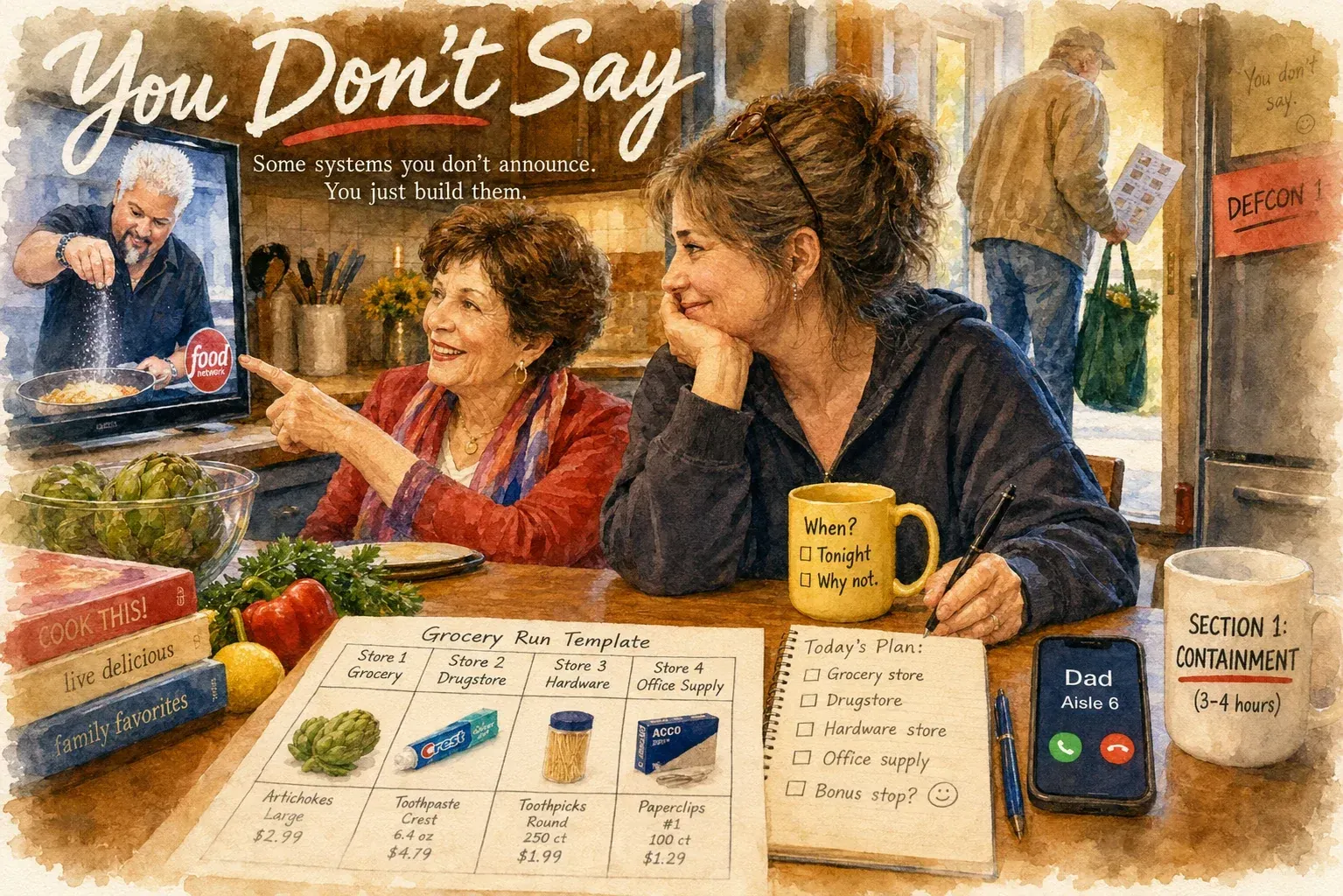
After Yiayia (my grandmother) died, I ran the kitchen. Mother didn’t boil water and felt that kitchens should be an optional part of the floor plan.
Her position was stated clearly and without apology: “Do whatever you want. I’ll clean up. I would eat glue rather than cook.” Not a complaint. A division of labor, and it worked.
What I hadn’t anticipated was Food Network.
Mom discovered it sometime in the early years of my kitchen-commander era. It changed everything. The summons would come from the other room: “Come into the kitchen. I want to show you something.” She would point at the screen.
“Do you think we should try this?”
“Sure, when?”
“How about tonight?”
“Why not.”
“No” wasn’t in our vocabulary where the other one was concerned.
So we would send Dad off to the store to pick up what we needed.
Dad was the more complicated project.
He was still capable of going out, driving, talking to everyone he knew, and handling most of his day. But afternoons were a different matter.
Errands had become oddly specific. “Pick up toothpaste” was no longer a complete instruction. Brand mattered. Size mattered. Sometimes the package mattered. And if I sent him out with too little information, the phone would ring from aisle six.
He required three to four hours of containment away from Mother, which had to be reinvented every day because the same thing two days in a row never worked.
Nobody said why out loud. We just kept reinventing.
The grocery run was always the anchor. Three stores scattered over a five-mile radius, plus one eight miles away, enough stops to fill the afternoon, enough variety to make it a proper outing. Drugstores. Hardware stores. The office supply store for paperclips when I was desperate. Close enough, also, for a toothpick emergency—a category of errand I had not previously known existed and which turned out to be surprisingly versatile.
The list was the real invention.
I made a template. A table, two cells per item: The bottom cell held the name, the size, and the approximate price. The cell above it held a photo of the exact product. Printed. One page per store. An hour every night. Because “go get artichokes” had stopped being enough information, and no one was ready to say why.
It was, I want to be clear, a very good template. An hour every night to buy three or four hours of peace.
Dad would call home from the aisle anyway.
“Which one of these do you want?”
“The one in the photo. Ask them to help you find it.”
The calls from people in town were a heightened category. People who had known Dad for years and who meant well and wanted to give us a heads-up.
“I thought you should know your father was having a little difficulty today.”
I would thank them warmly and look at Mom.
“You don’t say.”
“DEFCON 1.”
We said it only to each other, in the kitchen, in that particular tone of two people who had built an entire operational system around a situation they had not yet named directly.
That’s the thing about coping systems. You don’t announce them. You build them out of sheer necessity.